In short (TL;DR)
- What it is: software EGR valve deprogramming – the ECU no longer demands EGR flow or drops into limp mode.
- What we do: the software part only. Physical removal is carried out by our partner workshop in Vilnius.
- Price: from €50. Currently running: DPF + EGR for €50.
- Fault codes: P0400–P0408 and P2413, grouped below by whether the fault is flow or electrical. Note: P2453–P2455 are DPF codes, not EGR.
- A blanking plate alone does not work on most cars – P0401 or P2413 appear. The exception is older vacuum valves with no position sensor.
- Coolant disappearing with no leak, plus white smoke? That can be the EGR cooler rather than a head gasket – the wrong part often gets replaced.
- Legal position: it does not meet the requirements for cars used on public roads. We provide it for motorsport, closed circuits, export, off-road and agricultural machinery.
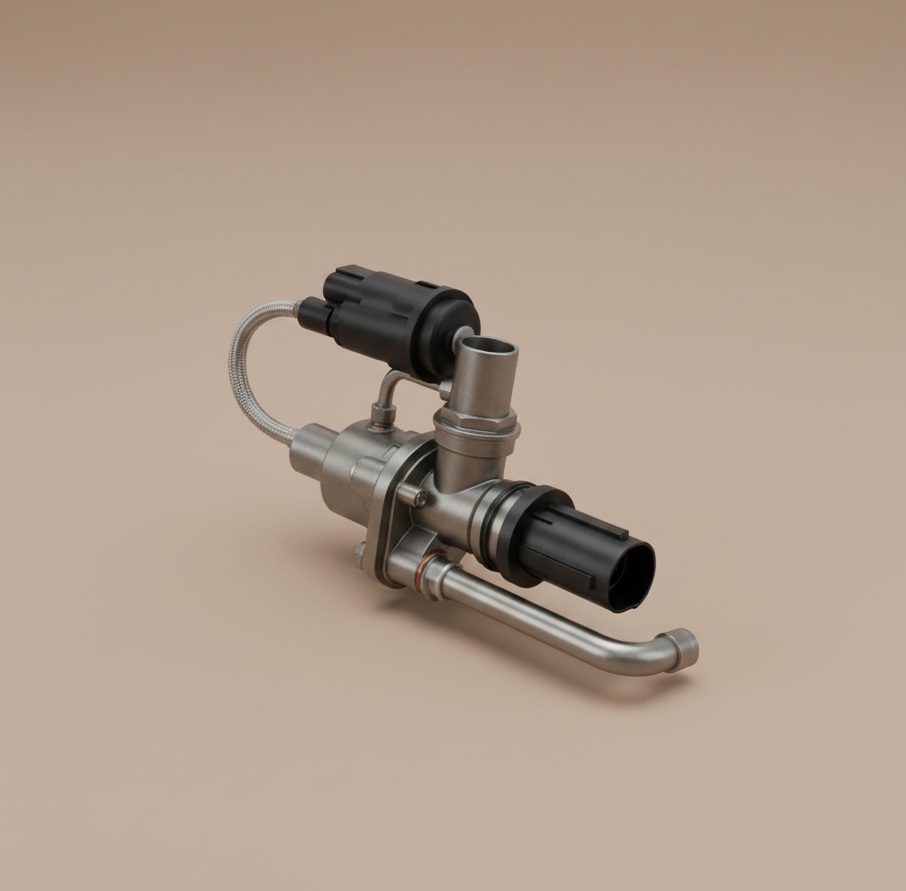
Software EGR (exhaust gas recirculation) valve deprogramming for diesel cars of every make. We individually adjust the engine control unit (ECU) software so the system no longer demands EGR flow and no longer drops into limp mode because of a clogged valve.
About scope. We do the software part. Physical removal or blanking is carried out by our partner workshop in Vilnius – see DPF removal and catalytic converter cutting. Our price from €50 covers the software work. Currently running: DPF + EGR deprogramming – €50.
When EGR deprogramming is needed
- Engine warning light on, with diagnostics showing EGR fault codes (see the code table below)
- The car drops into limp mode with reduced power
- Unstable idle, hesitation, smoke, lost power
- The valve sticks open or closed because of soot deposits
- The intake manifold is coated in tar-like deposits – often only visible once the manifold comes off
- Coolant disappears with no visible leak and white smoke comes from the exhaust – this can indicate a failed EGR cooler rather than a head gasket
EGR fault codes and what they mean
Most competitors list one or two codes. Below is the full verified set from OE supplier MS Motorservice / Pierburg, grouped by what the code actually indicates.
| Code | Official description | What it means in practice | Group |
|---|---|---|---|
| P0400 | EGR system – flow malfunction | Flow is wrong, or not detected at all | Flow |
| P0401 | EGR system – insufficient flow | Too little gas recirculated: valve not opening fully, or passages blocked | Flow |
| P0402 | EGR system – excessive flow | Valve not closing fully, stuck open | Flow |
| P0403 | EGR control circuit malfunction | Control signal implausible | Electrical |
| P0404 | EGR control circuit range/performance | Flow or position outside the set-point range | Measurement |
| P0405 | EGR sensor A circuit low | Position-sensor wear, short circuit | Electrical |
| P0406 | EGR sensor A circuit high | Same sensor-circuit family | Electrical |
| P0407 | EGR sensor B circuit low | Second sensor circuit | Electrical |
| P0408 | EGR sensor B circuit high | Second sensor circuit | Electrical |
| P2413 | EGR system performance | Actual flow does not match what the ECU commanded | Flow |
The grouping matters because flow codes usually mean a mechanically blocked or stuck valve, while electrical codes mean a sensor or circuit fault. Those are different jobs at different prices.
A note for anyone researching online: codes P2453, P2454 and P2455 are frequently misattributed to EGR – they are DPF pressure-sensor codes, not EGR.
Three types of EGR valve – and why it matters
| Type | How it works | Era | How it fails | Does blanking alone work |
|---|---|---|---|---|
| Vacuum (pneumatic) | Spring-loaded diaphragm operated by intake vacuum via a solenoid | Roughly 1970s–1990s, Euro 1–2 | Ruptured diaphragm, vacuum line leaks, sticking pintle | Sometimes – if there is no position sensor and the ECU does not verify flow |
| Electric (motor-driven) | DC or stepper motor sets position precisely | Euro 3–4 onward | Motor and gear wear, position-sensor drift, soot jamming the stem | No – the ECU detects the missing flow |
| Digital (solenoid) | Electromagnet opens and closes in pulses | Varies, PWM control | Burnt-out coil, seat sticking | No |
Is a mechanical blanking plate enough
Blanking plates are sold cheaply online – a thin metal gasket that closes the passage between the EGR valve and the intake manifold. They are marketed as a simple fix, and for most cars that is not true.
The reason is technical. A modern ECU does not merely check whether the valve moved: it compares its commanded position against the position sensor's feedback, and additionally assesses flow using the differential-pressure sensor and mass-airflow readings. With the passage blanked the valve still moves but there is no flow – so insufficient-flow codes appear, typically P0401, P0400 or P2413, and in some cases limp mode engages.
The exception is real but narrow: on older vacuum valves with no position sensor the ECU has no way to detect that flow stopped, so no codes may appear. That is not a general rule but a property of the specific car, established during diagnostics.
So the answer is simple: on most cars, blanking without the software work only lights the warning lamp and solves nothing. We do not recommend it as a standalone solution.
Four possible solutions
| Solution | What it involves | Fault codes | How long it lasts | Who does it |
|---|---|---|---|---|
| EGR cleaning | Valve removed and cleaned; the intake manifold must be cleaned too | None – the system stays functional | Temporarily: the soot source remains, deposits re-form | Other workshops |
| New valve | Original or aftermarket valve | None | Until it blocks again | Other workshops |
| Mechanical blanking without software | A plate in the passage | Appear – P0401, P0400 or P2413 | Does not solve the problem | We do not recommend it |
| Software deprogramming | ECU software adjustment, with physical removal where needed | None – the system no longer demands flow | Permanently | Us + partner for the physical part |
The EGR cooler – a fault often mistaken for a head gasket
The EGR cooler passes hot exhaust gas through thin tubes surrounded by engine coolant. The temperature difference is large – gas around 800 °C against coolant around 200 °C – so thermal cycling eventually cracks the tubes.
Coolant then enters the exhaust or intake tract, and the symptoms look like this: coolant disappears with no visible leak, white smoke comes from the exhaust, and the engine may overheat. That is almost indistinguishable from head-gasket failure, so the wrong part often gets replaced. A cracked cooler core cannot be welded – it must be replaced.
We check this possibility separately during diagnostics, because getting it wrong here is expensive.
Why EGR and DPF are connected
EGR exists because of nitrogen oxides. Recirculated gas dilutes the intake charge, so there is less oxygen and a lower combustion temperature – and NOx forms precisely at high temperatures. It works: EGR cuts NOx by roughly 50–70% at a cost of about 2–5% more fuel.
But there is an engineering tradeoff that cannot be avoided: less oxygen means more soot. So EGR reduces NOx while increasing particulates – the same soot the DPF has to capture.
The link runs both ways. A valve stuck open increases soot production and the DPF blocks faster. Conversely, a blocked DPF raises exhaust backpressure, and because EGR draws from that same high pressure, soot is pushed back into the intake. There it mixes with crankcase oil vapour and forms a tar-like, glue-consistency deposit that chemical cleaners no longer shift – it has to be removed mechanically. That is exactly why cleaning the valve alone, without the manifold, leads to rapid re-fouling.
The practical conclusion: the correct order of work is diagnostics → EGR and intake manifold → only then the DPF. Otherwise a freshly cleaned filter is reloaded from a source that was never addressed.
If the car also has AdBlue (SCR), it is worth knowing that disabling EGR while leaving SCR active means the NOx sensor readings no longer match what the system expects, and AdBlue faults can appear later. We assess them together rather than separately.
High-pressure and low-pressure EGR
Older engines have a single high-pressure circuit, taking gas from before the turbine. Newer ones added a low-pressure circuit that takes gas after the DPF and returns it before the turbocharger – cleaner and cooler, giving a better NOx-to-soot balance. Contemporary engines often have both at once.
The practical consequence: two circuits, two coolers and more complex diagnostics, so the work involved is greater on such cars. For example, the VW Group EA288 generation has both circuits, while the older EA189 has high-pressure only.
Engines we cover
The scope of work is determined not by the badge but by the ECU type and the exact engine code. The full engine list with codes is on the DPF deprogramming page – the same engines have an EGR system. Below is the EGR-specific detail.
| Engine | Valve type | EGR specifics |
|---|---|---|
| VW 1.9 TDI PD (BXE, BLS, BKC) | Electric | Valve sooting and sticking; intake manifold deposits. These engines have no swirl flaps |
| VW 1.6 / 2.0 TDI EA189 | Electric with cooler | High-pressure circuit only. Well-documented intake manifold and swirl-flap clogging |
| VW 2.0 TDI EA288 | Electric | High AND low-pressure circuits – more work involved, tighter OBD monitoring |
| BMW M47 / M57 | Vacuum or electric by year | Valve sticking, cooler fouling |
| BMW N47 / N57 / B47 / B57 | Electric with cooler | Cooler problems – see the BMW recall note below |
| Mercedes OM651 | Electric | Valve sticking; cooler cracking with coolant loss and white smoke |
| Mercedes OM642 3.0 V6 | Electric | The classic swirl-flap problem, code P2015; the plastic flaps break. Often addressed together with EGR work |
| PSA / Ford DV6 1.6 HDi / TDCi | Electric | Heavy valve and intake soot fouling |
| PSA / Ford DW10 2.0 HDi / TDCi | Electric, often with cooler | Cooler fouling and valve clogging |
| Opel 1.7 CDTI (Z17DTH) | Vacuum | Isuzu design; valve sticking, manifold deposits |
| Opel 1.9 CDTI (Z19DT / DTH) | Vacuum or electric by variant | Fiat design with cooler |
| Volvo D5 (5-cyl) | Electric | The cooler is a known weak point, with coolant loss |
| Toyota 1KD / 2KD, 1AD / 2AD D-4D | Electric with cooler | Well-documented EGR and intake coking, cooler blockage |
On the shared PSA and Ford engines: the DV6 and DW10 are the same mechanical base, but Peugeot/Citroën (HDi) and Ford (TDCi) use different software and EGR control strategies. The mechanical failures are the same, but fault codes and software files depend on the badge, not just the block.
On BMW: in 2018 BMW recalled roughly 1.6 million diesel vehicles worldwide over the EGR cooler – leaking coolant on hot soot deposits can, under certain conditions, smoulder and damage the intake manifold. Public reporting associates this with the N47, N57, B47 and B57 generations, but the exact model and year scope varies by market, so a specific car is worth checking by VIN in BMW's own or the regulator's recall database. If the cooler has not yet been replaced, we will say so.
Roadworthiness testing and the legal position
Plainly stated: disabling the EGR system does not meet the requirements for vehicles used on public roads – the car no longer complies with the emissions standard it was certified to. In Germany this is put directly: under §19 StVZO a modification that worsens emissions behaviour causes the vehicle's type approval to lapse.
One thing is worth understanding: the legal position does not depend on whether an inspector notices. So we do not promise that roadworthiness testing will be passed, and we do not offer solutions whose purpose is to circumvent it. If the car is used on the road and needs testing, the appropriate solution is cleaning or replacing the valve – and that is what we will tell you.
We provide this service for vehicles and machinery not used on public roads: motorsport, closed circuits, export, off-road and agricultural equipment.
Price
The software work starts from €50; the final figure depends on the ECU type, and newer Euro 6 units with two EGR circuits require more work. Currently running: DPF + EGR deprogramming – €50. Physical removal is quoted separately by our partner.
We always run diagnostics first. If the problem turns out to be mechanical – cooler, swirl flaps, turbocharger, injectors – that has to be fixed first, because software does not solve a mechanical defect.
Frequently asked questions
Is fitting a blanking plate enough?
On most cars, no. A modern engine control unit compares its commanded valve position against the sensor's feedback and additionally assesses flow from pressure and mass-airflow readings. With the passage blanked the valve moves but there is no flow, so insufficient-flow faults appear – typically P0401, P0400 or P2413 – and limp mode can engage. The exception is older vacuum valves with no position sensor: there the ECU has no way to detect that flow stopped. We establish which case applies during diagnostics on the specific car.
Is EGR deprogramming legal?
Not if the car is used on public roads. With EGR disabled the car no longer complies with the emissions standard it was certified to; in Germany, under §19 StVZO, such a modification causes type approval to lapse. We therefore provide the service for machinery and vehicles not used on public roads: motorsport, closed circuits, export, off-road and agricultural equipment. If the car is used on the road, the correct solution is cleaning or replacement.
Will I pass roadworthiness testing?
We do not promise that you will, and we do not treat it as the purpose of the service. The legal position does not depend on whether an inspector notices the change – the car either meets the requirements or it does not. We do not offer solutions whose purpose is to circumvent testing. If testing is required we recommend cleaning or replacement, and we will also tell you what that costs.
Does cleaning the EGR valve help?
It helps, but temporarily, and only if more than the valve is cleaned. Soot mixes with crankcase oil vapour to form a tar-like deposit in the intake manifold and passages; clean only the valve and that deposit remains and re-fouls it quickly. So cleaning has to include the manifold. More importantly, the soot source does not go away: as long as EGR operates, deposits keep forming, which makes cleaning a maintenance task rather than a final solution.
Can EGR cause coolant loss and white smoke?
Yes, and it is often confused with a head gasket. In the EGR cooler, hot gas passes through thin tubes surrounded by coolant; the temperature difference eventually cracks them and coolant enters the exhaust or intake tract. The symptoms are coolant disappearing with no visible leak, white smoke, and possible overheating. A cracked cooler core cannot be welded and must be replaced. We check this separately before starting, because replacing the wrong part here is expensive.
Will disabling EGR increase power and cut fuel consumption?
We do not promise specific percentages – those figures depend on the engine and its starting condition, so a precise promise would be irresponsible. What can be said firmly: EGR cuts NOx by roughly 50–70% while consuming about 2–5% more fuel, and a stuck or blocked valve disrupts running and can trigger limp mode. Removing those causes makes the engine run more consistently. One correction worth noting: it is sometimes written that disabling EGR lowers engine temperature – in fact the opposite is true, because EGR exists to lower combustion temperature, so disabling it raises it.
How is EGR connected to the DPF?
Directly, and in both directions. EGR reduces NOx but, because of the lower oxygen content, increases soot – the same soot the DPF captures. So a valve stuck open blocks the DPF faster. Conversely, a blocked DPF raises exhaust backpressure and soot is returned through the EGR into the intake, where mixed with oil vapour it forms a tar-like deposit. That is why the order of work matters: diagnostics first, then EGR and the manifold, only then the DPF.
Can factory settings be restored?
Yes. Before any changes we read and save the original control unit software, so the factory software state can be restored – before a sale, for instance. Worth knowing: restoring the software state does not restore a valve that has been physically removed or blanked.
Will this damage the engine?
A software solution does not damage the engine in itself, but it does not fix mechanical defects. If there is already a worn turbocharger, leaking injectors, a cracked EGR cooler or broken swirl flaps, programming will not remove those problems. That is exactly why we run diagnostics first and, if we find a mechanical defect, recommend fixing that first.
Do you work with all makes?
Yes – the scope of work is determined by the control unit type and the exact engine code, not the badge. The list of engines we cover with EGR specifics is in the "Engines" section of this page, and the full engine-code list is on the DPF deprogramming page, since the same engines have both systems. If you do not know your engine code, we will establish it during diagnostics.